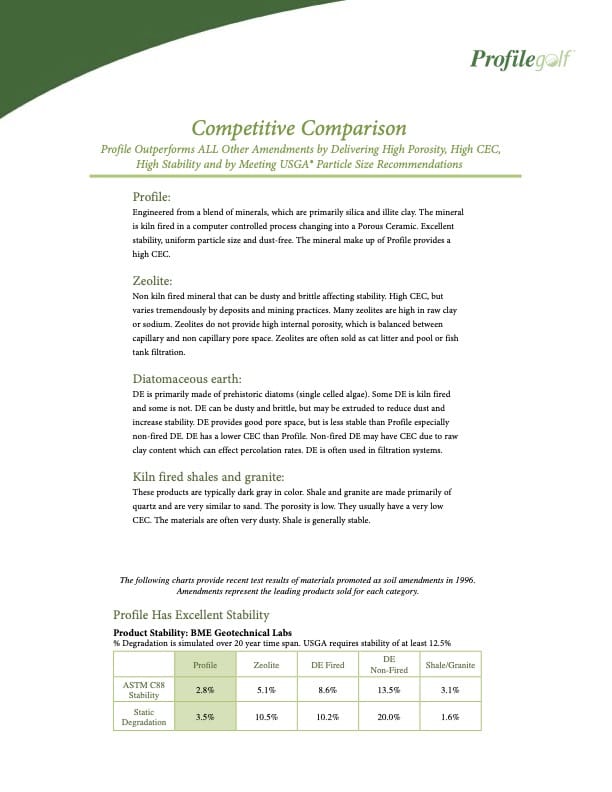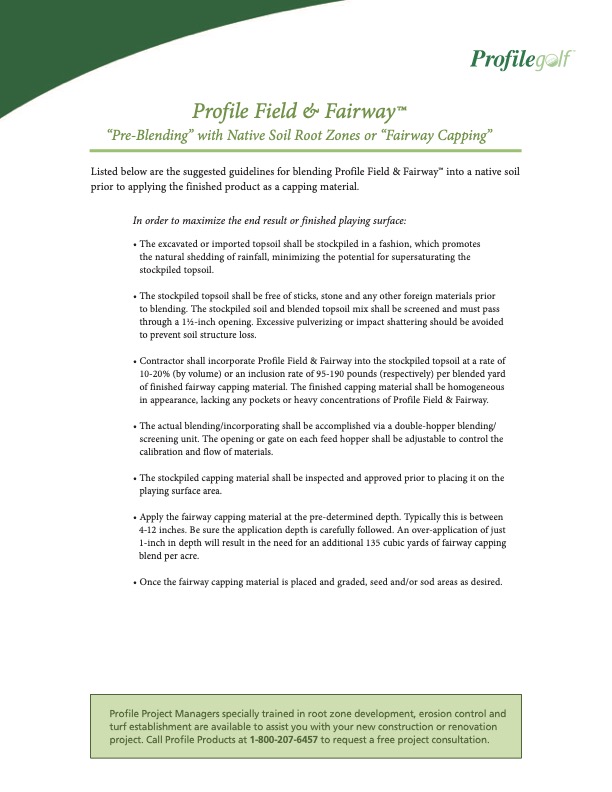
Your Soil Structure Guide explains how soil composition and pore space affect turf health on golf courses, comparing ideal soil, native soils, sand-based root zones, and sand/peat mixes. It highlights how Profile® Porous Ceramic and Profile Field & Fairway® help balance air and water pore space, improve moisture and nutrient retention, and resist compaction in both sand-based and native soil root zones. Backed by physical testing and university research, including drought-stress modeling and salinity leaching studies, the guide shows how these amendments support construction, renovation, and ongoing maintenance through topdressing, aerification, and project management support across the course.
Key Points
- Ideal soil contains 50% solid and 50% pore space, with pore space split between capillary (water holding) and non-capillary (air holding and drainage).
- Profile Porous Ceramic delivers high total porosity of 74%, with 39% water, 35% air, 26% solid and a CEC of 33 meq./100g.
- A sand/Profile blend showed an 18% increase in drainage and 18% increase in total porosity compared to 100% sand, while maintaining balanced air and water pore space.
- Computer modeling at The Ohio State University found that a root zone amended with 15 percent by volume Profile Porous Ceramic can delay the onset of visual drought stress by up to 3 days compared to unamended sand.