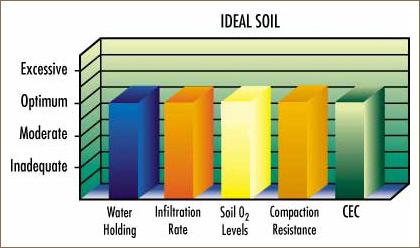
Ideal soil balances air- and water-holding pore space, resists compaction, holds nutrients and provides turf with a growing medium that enhances growth and recovery, which significantly reduces long-term maintenance costs.
Ideal Athletic Field Soil Characteristics
- Balanced porosity for optimum water holding capacity, drainage rates and oxygen levels.
- Resists compaction maintaining ideal soil for outstanding turf.
- High nutrient retention (CEC).
Porosity In Balance
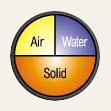
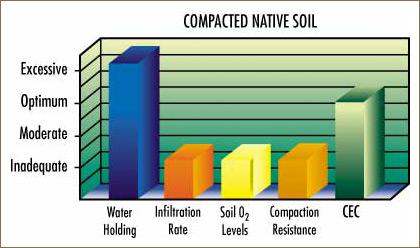
Compacted Native Soil
- Native soils are not resistant to compaction, which leads to turf failure and unsafe conditions.
- Root zone drains poorly, depriving the plant of sufficient air space for turf recovery.
Porosity Out of Balance
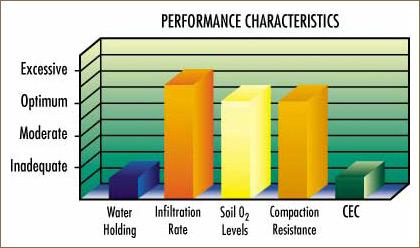
100% Sand Root Zones
- Poor storage reservoirs for water and nutrients.
- Requires a higher level of maintenance.
Porosity Out of Balance
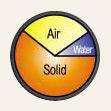
Turface Particle as Example of Calcined Clay
Turface® MVP® or Field & Fairway™ for native soil and Greens Grade™ for sand root zones are used to permanently modify soils to provide athletes with safe, playable and beautiful fields. Turface will:
- Add permanent water, nutrient and air holding space (pore space) to soils to help prevent turf damage and aid in turf recovery even under intense athletic traffic.
- Condition athletic field soils to resist compaction in wet and dry weather.
- Absorb excess water during rains to prevent muddy, torn-up turf.
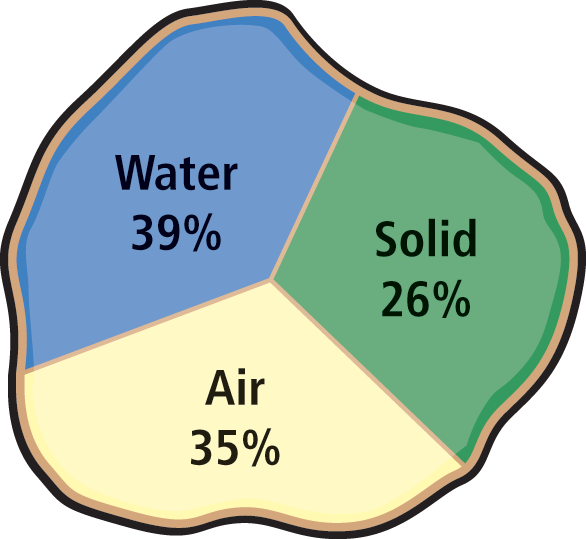
Turface granules have 74% pore space which allows them to hold water and oxygen in a nearly perfect balance. They also store nutrients vital to plant growth.
- Stable particles have less than 3% degradation in 20 years.
- High nutrient storage (CEC of 33 meq/100g).
- Nearly perfect balance between air and water porosity.
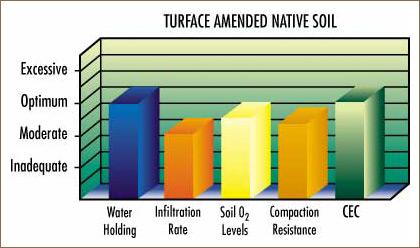
Native Soil Amended with Turface or Profile Greens Grade
- Turface adds permanent porosity to the soil, which improves drainage, increases oxygen levels and helps the soil resist compaction.
- Soils modified with Turface maintain ideal soil characteristics for superior athletic fields.
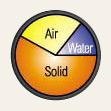
80% Sand / 20% Profile Greens Grade
- Profile Greens Grade increases water holding, drainage and nutrient retention.
- Profile Greens Grade/sand root zones hold up to intense athletic traffic.
- Similar results could be expected from Turface MVP or Pro League.
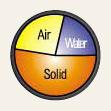
Porosity Almost Ideal
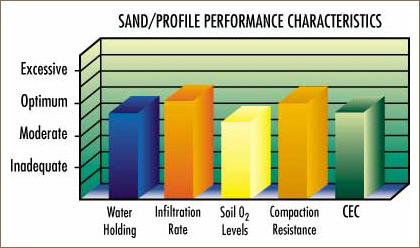
Study of Profile Greens Grade for Sand Root Zones
Profile Greens Grade replaces peat and dramatically improves the moisture and nutrient holding ability of sand root zones. Unlike peat, Profile Greens Grade improves the drainage of sand root zones for today’s high-performance athletic fields. Profile Greens Grade is used in many NFL, college, and high school sand-based fields, as well as thousands of golf greens. Over the life of sand-based athletic fields constructed with Profile Greens Grade, there are substantial savings reported by groundskeepers:
- Accelerated grow-in.
- Reduced water usage up to 20%.
- Reduced fertilizer usage up to 25%.
- Reduced core aerification up to 50%.
- Reduced chemical treatments for disease and algae.
Profile Greens Grade increases drainage at the same time it increases moisture retention, a result of balancing air and water pore space in the root zone.
80% / 20% Sand / Amendment Mix
| 100% Sand | w/Peat | w/Profile® | |
|---|---|---|---|
| Perk Rate inches/hour Saturated Hydraulic Conductivity USGA | 26.6 | 14.0 | 33.0 |
| Non Capillary Pore % | 21.4 | 17.5 | 24.1 |
| Capillary Pore Space % | 18.1 | 26.6 | 20.7 |
| Total Pore Space % | 39.5 | 44.1 | 44.8 |
| Bulk Density (grams per cubic centimeter) | 1.6 | 1.5 | 1.5 |
| Water Retention at Field Capacity % | 11.3 | 18.3 | 14.3 |